














|
Firouzabad is a town in Fars province about 110 kilometres south of Shiraz, surrounded by a mud wall and ditch. It had an estimated population of 67,909 in 2005 AD.
Alexander III of Macedonia (known by Europeans as "Alexander the Great") destroyed the original city of "Gur". Centuries later, Ardashir I, founder of the Sassanid Dynasty, revived the city before it was ransacked during the Arab invasion of the 7th century.
Firouzabad is situated in a low-lying area of the region, so Alexander was able to drown the city by directing the flow of a river into the city. The lake he created remained until Ardashir I built a tunnel to drain it. He founded his new capital city on this site.
|
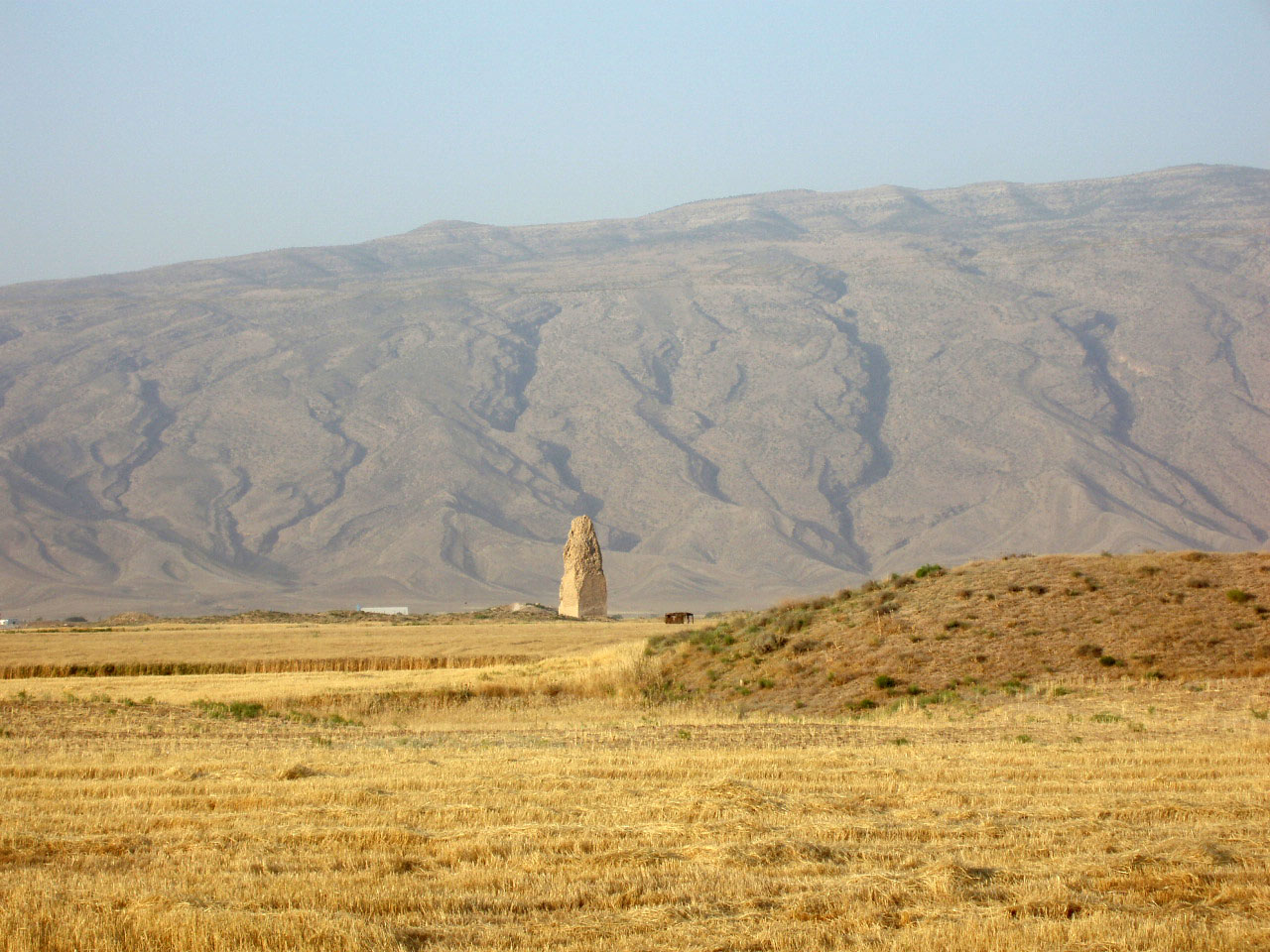
Remained of ancient city of Gur (photo courtesy) |

Ardashir's new city was known as "Khor Ardeshir", "Ardeshir Khuarah" (means "Glory of Ardashir") and "Shahr-e Gur". It had a circular plan so precise in measurement that the Persian historian Ebn-e Balkhi wrote it to be "devised using a compass". It was protected by a trench 50 metres in width, and was 2 kilometres in diameter. The city had four gates; to the north was the "Hormoz Gate", to the south the "Ardeshir Gate", to the east the "Mithra Gate" and to the west the "Bahram Gate". The royal capital's compounds were constructed at the centre of a circle 450m in radius. At the centre point of the city was a Zoroastrian fire temple 30m high and spiral in design (see photo no #), which is thought to have been the architectural predecessor of the Great Mosque of Samarra, Iraq.
The city's importance was revived again in the reign of Azod-od-Dowleh of the Daylamite dynasty, who used the city as his frequent residence. It is at this time that the old name of the city (Gur), is abandoned in favour of the new. In New Persian spoken at the time Gur had come to mean "grave". King Azod-od-Dowleh, as the story goes, found it distasteful to reside in a "grave". Per his instruction, the city's name was changed to "Pirouz-abad" (= "City of Victory" in Persian). Since then, the city has been known by variations of that name, to include "Firouzabad".
Among the attractions of the city are the "Ghal'eh Dokhtar" (="Maiden's Castle" in Persian), the "Palace of Ardashir", and the fire temple tower among the remains of Gur.
The people of modern Firouzabad are mostly descendants of the Qashqai. They used to live along the Amu Darya River before fleeing before Genghis Khan to Fars.
Ref:
-
Wikipedia, the Free Encyclopaedia
Further information is also available at:
-
Prof Dietrich Huff, Firuzabad (Ardashir-Khurreh), CAIS
-
Satellite image of ancient city of Gur by Google Map